Ten Seconds Flat: How to Spot the Hand in a Handmade Wooden Gift
Stand in any big-box store's gift aisle this holiday season and you'll see them: wooden coasters, cutting boards, little engraved boxes, all suspiciously identical. Same sheen, same edges, same everything. Then walk a craft fair in Asheville or Portland or a small town square anywhere in between, and something changes. The wood looks... alive. Most people feel that difference before they can name it. The good news? You can learn to name it in under ten seconds.
The Shine Test: Where the Light Goes to Hide
Start with the finish. Factory finishing is, by design, uniform—a sprayed coat that lands on every board exactly the same way. That's why mass-produced pieces often have a glassy, plastic-like gloss, especially in the crevices where spray pools.
Hand-rubbed finishes behave differently. Oil finishes like tung or walnut oil soak into the grain rather than sitting on top, leaving a soft, matte luster that feels more like a river stone than a bowling ball. Run your thumb across it. A handmade piece usually feels warm and slightly textured; a machine piece feels like touching a phone screen.
Follow the Grain Into the Corners
Here's the tell we love most at the workbench: look at where two surfaces meet. On a machine-made box or board, the grain on the sides and the top often runs in different directions with no relationship to each other—because a computer optimized the cut for yield, not beauty.
A craftsperson does the opposite. They'll hunt through a lumber rack for an hour to find boards where the grain wraps continuously around a corner, flows through a handle, or mirrors itself across a lid. That continuity takes time, skill, and honestly, a little obsession. Machines don't have obsessions.
Tool Marks: The Signature Nobody Fakes Well
Sandpaper hides a lot, but not everything. Look closely at curves and edges:
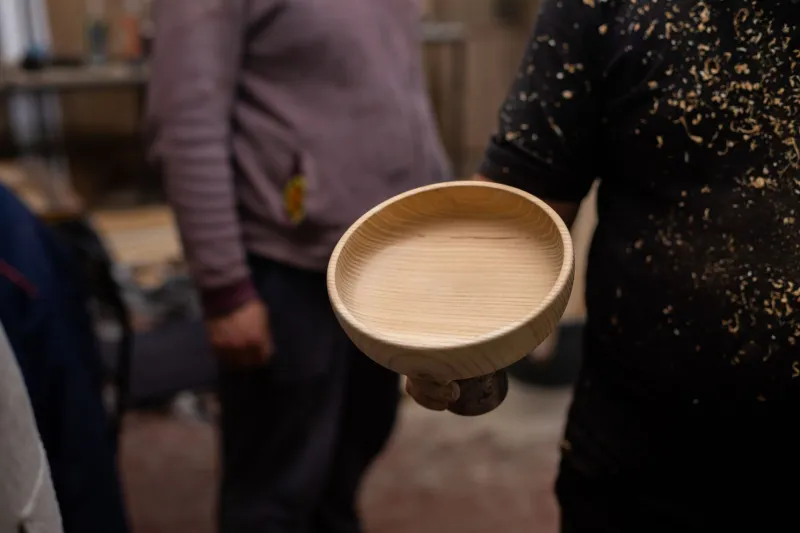
- Slight faceting on curves. A hand-carved spoon or bowl often shows faint flat spots where the blade passed, like a stone polished by a stream rather than a tumbler.
- Soft, uneven edges. Hand-sanded edges round off irregularly. Router-factory edges are perfectly consistent, which sounds like a compliment but isn't.
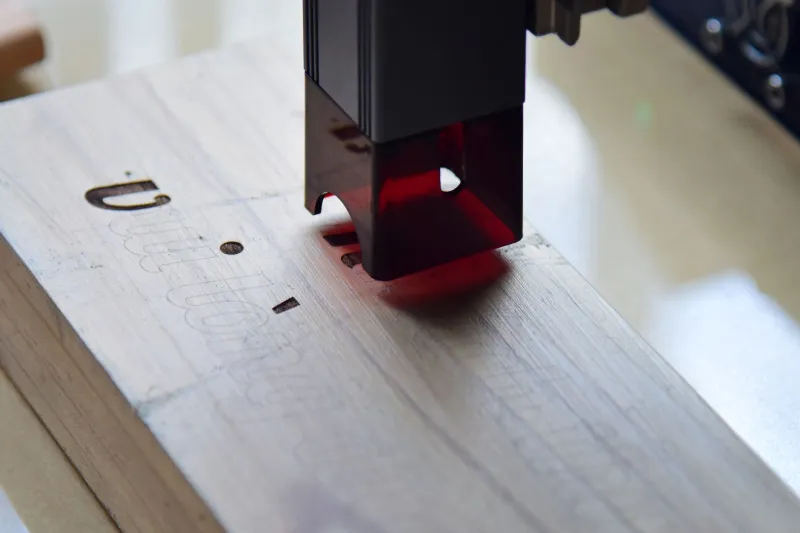
- The underside tells the truth. Flip it over. Makers spend their finishing time where hands and eyes go; factories finish everywhere identically because a machine doesn't know the difference. A handcrafted piece might have chisel marks or saw traces on the bottom—honest evidence of the process.
Asymmetry Is the Point, Not the Flaw
We've written before about the knot in the middle and why a little wobble makes a gift worth keeping. This is the same idea from the other direction: perfect symmetry is a fingerprint of automation.
Dovetails on a handmade box won't be twins. The spacing will breathe—slightly wider here, slightly narrower there—because human hands laid them out. On a turned bowl, the walls might vary by a millimeter in thickness. None of this is sloppiness. It's the visible record of a person making hundreds of small decisions in real time.
The Story Test at Craft Fairs and Online
The physical tells only get you so far when you're shopping online, so add these questions:
- Can they name the wood and where it came from? A real maker says "walnut from a storm-felled tree in Ohio," not just "premium hardwood."
- Do the product photos show variation? If every listing looks identical down to the grain pattern, that's a red flag. Wood doesn't do copy-paste.
- Is there a maker, with a name and a place? Etsy and Instagram have made this easier, but so has the art of looking handmade while shipping by the pallet. Read the about page. Real artisans talk about their shop, their process, their mistakes.
- Does the price make sense? Handcraft takes hours. If a hand-carved keepsake box costs less than a pizza dinner, someone's hands aren't actually in it.
What You're Really Paying For
Here's our opinion, stated plainly: when you buy a handcrafted wooden gift, the lumber might be twenty dollars. The finish, maybe ten. What you're actually purchasing is the invisible fingerprint of a maker—the accumulated decisions, the trained eye, the years of shavings on the shop floor.
A machine-made piece isn't evil; it has its place. But it can't carry a story, because nobody made a choice while creating it. A handmade piece carries thousands of them.
So the next time you're holding a wooden gift and wondering whether it's the real thing, give it ten seconds. Check the finish. Follow the grain. Flip it over. The hand, as the old woodworkers say, always leaves a trace—and once you've learned to see it, you'll never unsee it.