The Knot in the Middle: Why a Little Wobble Makes a Wooden Gift Worth Keeping
Photo: A S M Jobaer, CC BY-SA 4.0, via Wikimedia Commons
There's a moment that happens at every craft fair in America. A shopper picks up a hand-planed serving board, runs a thumb across a gentle ridge left by the blade, and asks the question every woodworker has heard a hundred times:
"Is this... supposed to be like that?"
The answer, almost always, is yes. And not just yes — thank goodness yes.
What a Machine Can't Do
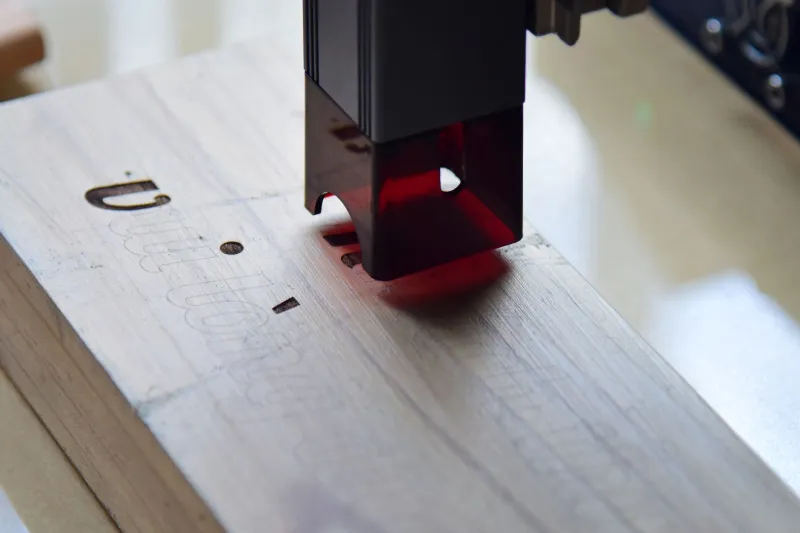
Walk into any big-box home store and you'll find walls of decor that look identical because they are identical. CNC routers and factory finishing lines are built to eliminate variation. Every board comes out the same. That's the whole point.
But here's the thing about sameness: nobody frames a photo of it. Nobody tells the story of the mass-produced shelf they bought in 2019. Uniformity is convenient, and forgettable.
A handmade piece works differently. The small dip where the grain dipped and the craftsman followed it. The mineral streak running purple-gray through a slab of walnut. The corner that's a hair rounder than its twin because a human hand, not a program, guided the final pass. These aren't quality-control failures. They're a record of the day the piece was made.
Reading the Story in the Surface
Woodworkers talk about "listening to the board," and it's not just shop mystique. Hardwood is full of history — drought years written tight into the rings, the scar where a branch once grew, the sugar figures maple leaves behind in fall. A machine sands that story flat. An artisan works around it, sometimes even building the design around it.
As one second-generation furniture maker in North Carolina put it to us: "A knot isn't damage. It's where the tree fought to grow something. I leave it in on purpose. It's the part people point at ten years later."
That's the quiet secret of handcraft: the so-called imperfection is often the part the recipient falls in love with. The knot becomes the conversation piece. The tool marks catch the kitchen light in a way no factory finish can fake.
The Case for Paying More (Yes, More)
Let's be honest about the price tag. A handcrafted keepsake usually costs more than its big-box twin, and gift shoppers deserve a straight answer about why.
You're not just paying for lumber. You're paying for:
- Time. A single board can take hours of milling, shaping, sanding, and finishing by hand.
- Skill. Years of learning how a specific species behaves — how cherry darkens, how oak drinks oil.
- Selection. An artisan rejects most of what a factory accepts, choosing boards where the grain does something beautiful.
- Accountability. If something's wrong, you're emailing the person who made it, not a support ticket queue.
And unlike the mass-produced version, the handmade piece tends to hold value in the way that matters — emotionally. It becomes the cutting board that only comes out for holidays. The box that holds the baby's first haircut. Objects with wobble get kept; objects without it get replaced.
How to Spot Character (Not Defects)
Not every irregularity is charming, so here's a quick field guide for gift shoppers:
- Knots and mineral streaks: Character. Fully a part of the wood.
- Tool marks and slight asymmetry: The maker's signature. Embrace it.
- Color variation across the piece: Natural. Wood literally isn't paint.
- Loose joints, rough splinters, unfinished ends: Actual flaws. A reputable maker wouldn't ship these.
The line is simple: variation in the wood is a feature. Failure in the construction is a problem.
The Gift That Admits It's Human
When you give something handmade, you're quietly saying something about the relationship. I chose this. Nobody else has this exact one. It came from someone's hands.
A machine-perfect gift says "quality." A handcrafted one says "I thought of you" — and means it. The wobble is the proof.